Metered electricity.
Delivered kWh × an agreed tariff. Set service level, response, billing, escalation and contract term.
Tilo Power / Project room / 19 October 2026
The route to our first paying customer: validate demand, agree a viable electricity service, fund the installation and prove daily operation.
Measure one agreed load.
Study + proposal. No solar plant.
Customer and quotes unconfirmed.
The service is intended for businesses and public institutions, including hospitals, schools and public services. For the first project, compare a defined routine load at a hospital or hotel in Greater Banjul. Measure demand, compare the customer’s existing energy costs and build an offer they will accept. Confirm the operating plan and capital recovery before committing to installation. For a public institution, confirm the authorised contracting body, procurement route and approved payment budget before committing.
Delivered kWh × an agreed tariff. Set service level, response, billing, escalation and contract term.
Financing, qualified installation, monitoring, maintenance, repairs and separately agreed capacity upgrades.
Grid energy, generator fuel, major roof works and clinical UPS are explicitly scoped. No unapproved export income.
Can one measured load support a customer-accepted tariff that pays for the service and the capital?
These are proposed delivery requirements, not achieved impact or a commitment that all revenue stays in the country.
Agree the baseline, responsibilities and reporting with the first customer. Do not infer jobs, savings, grid support or community-wide access from an illustrative installation. Public-sector projects also need the authorised procurement and payment route.
Grid integration: qualify the utility connection, protection, isolation and transfer settings. No grid-support contract, export approval or utility partnership is secured. Recheck the case against improving grid supply.
Back to our delivery principlesCompare the same evidence for each candidate. An unknown stays open; it is not treated as a pass.
Name the organisation that can sign, the decision-maker, payment route and existing energy contract.
Owner / Dominik + Lamin
Ready when A named buyer and credible route to payment. For public sites: contracting authority, procurement route and approved budget.
Collect 12 months of electricity/fuel records, a load list, operating hours and consent for a qualified 14-day logging study.
Owner / Lamin; Joachim + specialists
Ready when A measured load block, seasonal gaps and the service boundary are explicit. No whole-building sizing from one bill.
Record Roof, Canopy or Ground options, tenure/permissions, safe access, photos and structural or ground constraints.
Owner / Lamin; qualified designers
Ready when Written access/rights and a feasible interface, subject to structural/electrical checks.
Survey grid, existing solar, generator, fuel responsibility, outages and any critical circuits.
Owner / Joachim + qualified specialists
Ready when 24/7 supply for agreed loads is qualified against night demand, poor-sun periods, storage degradation, backup availability, fuel and maintenance. Define response, exclusions and remedies; clinical continuity has its own specialist approval.
Compare existing supply, customer-owned solar and managed service, including a better-grid case.
Owner / Dominik; inputs from all three
Ready when Customer-reviewed terms and complete cost/collection model support the chosen investment gate.
Outage estimate: 86.9% in the World Bank’s Gambia 2023 country profile, rounded to 87% on the main page. The weighted estimate covers eligible formal private firms with five or more workers in the surveyed sectors. Healthcare, informal microbusinesses and several other sectors are excluded. Interviews took place with 162 firms in May–September 2023; outage questions are retrospective, not a 2026 operating forecast.
Grid reference: 14.90 GMD/kWh is PURA’s published 2023 commercial rate. Verify the current customer bill, class and later decisions before pricing. It is not a Tilo Power tariff, a savings claim or proof of willingness to pay.
Enterprise Surveys · country profileA customer can buy a system from local installers. Compare our lifetime delivered cost with that ownership option.
Greenlink already publishes lease references. Our proposed advantage is accountable metered delivery, transparent billing and dependable local support — still to be demonstrated.
A better grid reduces the value of our backup. Measure avoidable fuel, maintenance and interrupted work rather than count every existing cost as a saving.
Greenlink’s published Gambian project referencesLease and installed-project evidence rechecked 19 October 2026. Customer-specific asset and contract status remains unverified.
Our value must also hold as the grid improves. Compare current bills and outages with a better-supply scenario. 2026 grid context.
PURA’s 2023 determined rates, still displayed when checked 19 October 2026. Verify the actual bill, meter class and any later tariff decision before pricing. These are grid benchmarks, not Tilo Power prices or savings. PURA source.
Each step ends in a decision. Founder responsibilities coordinate the work; qualified specialists perform the required design, safety and legal checks.
Arrange three site conversations, collect 12 months of electricity and fuel records and select one suitable site. Identify the Roof, Canopy or Ground format and confirm roof/land rights. Coordinate a qualified site-interface survey, the electrician and 14-day load recording.
With qualified designers, check demand, structure or soil, access and grid/generator boundaries. Match the site to a proposed standard package.
Check the electricity buyer, payment route, current costs and a preliminary service offer.
A measured load, a named buyer, a package format and a clear service boundary.
Price the mounting, canopy or ground interface with qualified local partners. Check fabrication, foundations, transport, installation, spares and service availability.
Qualify the first reference package: compatible PV, battery, inverter/control families, capacity bands and mounting/structure options. Freeze a reusable bill of materials, drawings, tests and an exception rule.
Build the configuration price catalogue and full cash plan. Separate energy-kit, roof/canopy/ground works and platform-development costs. Confirm funding, approvals and a customer-reviewed kWh offer.
One qualified reference configuration, a fully quoted cash plan and an agreed electricity offer.
Prepare installation logistics and the local team. Record assembly steps, local supply sources and training so the next site can reuse the process.
Qualified specialists install and commission the reference system. Verify all operating/protection modes; record as-built changes and complete the reusable handover, test and maintenance package.
Secure funding and the customer agreement before ordering. Agree metering, tariff, invoicing, service response and insurance.
An accepted reference installation, required permissions and a documented package for repeat delivery.
Run local service with a shared checklist and spare-parts list. Track site issues, maintain customer contact and train the local team.
Review measured operation and revise the package library. Expand only within the qualified equipment, site-interface and connection envelope.
Track collections, full operating costs, reserves and capital recovery. Compare repeat-site economics; approve the next configuration only from measured results and complete quotes.
A proven reference service and a documented, costed route to the next site.
Visit three prospects. Rent a calibrated logger for 14 days at one qualified site. A qualified electrician installs it; an engineer interprets the result. No panels, battery or generator are bought.
$1,670 costs + $334 reserve + $250 refundable deposit.
| Input | USD |
|---|---|
| Energy logger rental · 2 weeks | $360 |
| Qualified electrician visits | $200 |
| Customer / site visits | $120 |
| Independent engineering analysis | $400 |
| Local field support | $140 |
| Data + printing | $30 |
| Initial tariff / contract review | $150 |
| Local travel + consumables | $120 |
| Provisional local taxes / permissions | $150 |
| Test-cost subtotal | $1,670 |
| 20% contingency | $334 |
| Refundable deposit · liquidity | $250 |
| Total cash required | $2,254 |
The deposit is cash tied up, not an immediate expense. No sales, resale or assumed refund is deducted. All local prices and permission/tax allowances require written offers. Founders’ time is unpaid; founder pay and travel are excluded.
A measured load profile, a common specification for comparable quotes, and a customer-reviewed kWh offer. It does not prove installed-system performance or uninterrupted supply.
The $360 logger line is an allowance anchored to a dated UK hire benchmark, not an offer delivered to The Gambia. Confirm calibration, local availability, rental rights, transport and deposit terms before booking.
Reconcile study costs with later engineering provisions. Do not mechanically add the validation and deployment budgets.
Choose a qualified platform configuration, then configure its capacity and Roof, Canopy or Ground interface for the site. A safe, billable service still needs site rights, commissioning and a local operating team.
Start with one qualified reference package. Reuse its component families, drawings, assembly steps, metering and service process. Select a format and capacity from that catalogue; assess the site before committing.
Pitched or flat
Use a suitable existing roof.
Parking or covered space
Build a useful roof and generate above it.
Spare land on your site
Place generation beside the buildings it serves.
Tilo Power arranges financing, qualified installation, metering, monitoring and maintenance. The customer buys metered electricity at an agreed kWh price. Storage, backup, roof works and expansion are explicitly priced and scoped; funding and contracts are not yet secured.
Qualified PV, inverter/control and storage families; connectors, protection templates, drawings, spares, commissioning, billing and service procedures.
Roof/Canopy/Ground format, approved capacity band, battery duty, number of bays and grid/generator operating mode.
Measured load, structure or soil, wind, corrosion exposure, drainage, safe access, land/roof rights and permissions.
These are Tilo Power product-design requirements to qualify, not claims that a certified proprietary structure or manufactured kit already exists.
Where it fitsBest first conversation when the roof is sound and daytime demand is strong.
The qualified interfaceVerify the exact roof profile, fasteners, structure and weather seals. Short rails suit some trapezoidal sheets; seam clamps suit compatible standing-seam profiles. Neither is universal.
Where it fitsFor usable flat roofs above schools, public buildings, hotels and routine service areas.
The qualified interfaceUse a qualified low-profile mounting arrangement. Roof load reserve, wind, membrane compatibility and drainage decide whether ballast or mechanical anchoring is appropriate; ballast is not automatically acceptable.
Where it fitsFor hospitals, schools, government buildings and business campuses with suitable parking.
The qualified interfaceRepeat a defined structural bay with clear vehicle and pedestrian routes. Specify foundations, weatherproof covering, drainage and protected equipment placement. Lighting and future charging circuits are separately scoped options.
Where it fitsFor a new sheltered work area or roof replacement already needed by the customer.
The qualified interfaceSpecify the structural frame, covering, drainage and PV as one qualified package. Solar modules alone are not a weatherproof roof. New construction needs a complete separate quote.
Where it fitsFor a hospital, school, water-pumping or production site with suitable adjacent land.
The qualified interfaceCheck land rights, soil/foundation tests, flood/drainage conditions, cable distance and security. Freestanding describes the structure, not automatic off-grid capability.
The same frame and panel dimensions must not be assumed for every capacity. Larger configurations need a qualified electrical band and compatible interfaces. A ground array can serve an agreed on-site load; an off-grid service needs a separately sized storage/backup design. Green roofs and tracking mechanisms are not part of the first standard catalogue.
Two illustrative scale journeys. The actual site and equipment limits decide which extension is allowed.
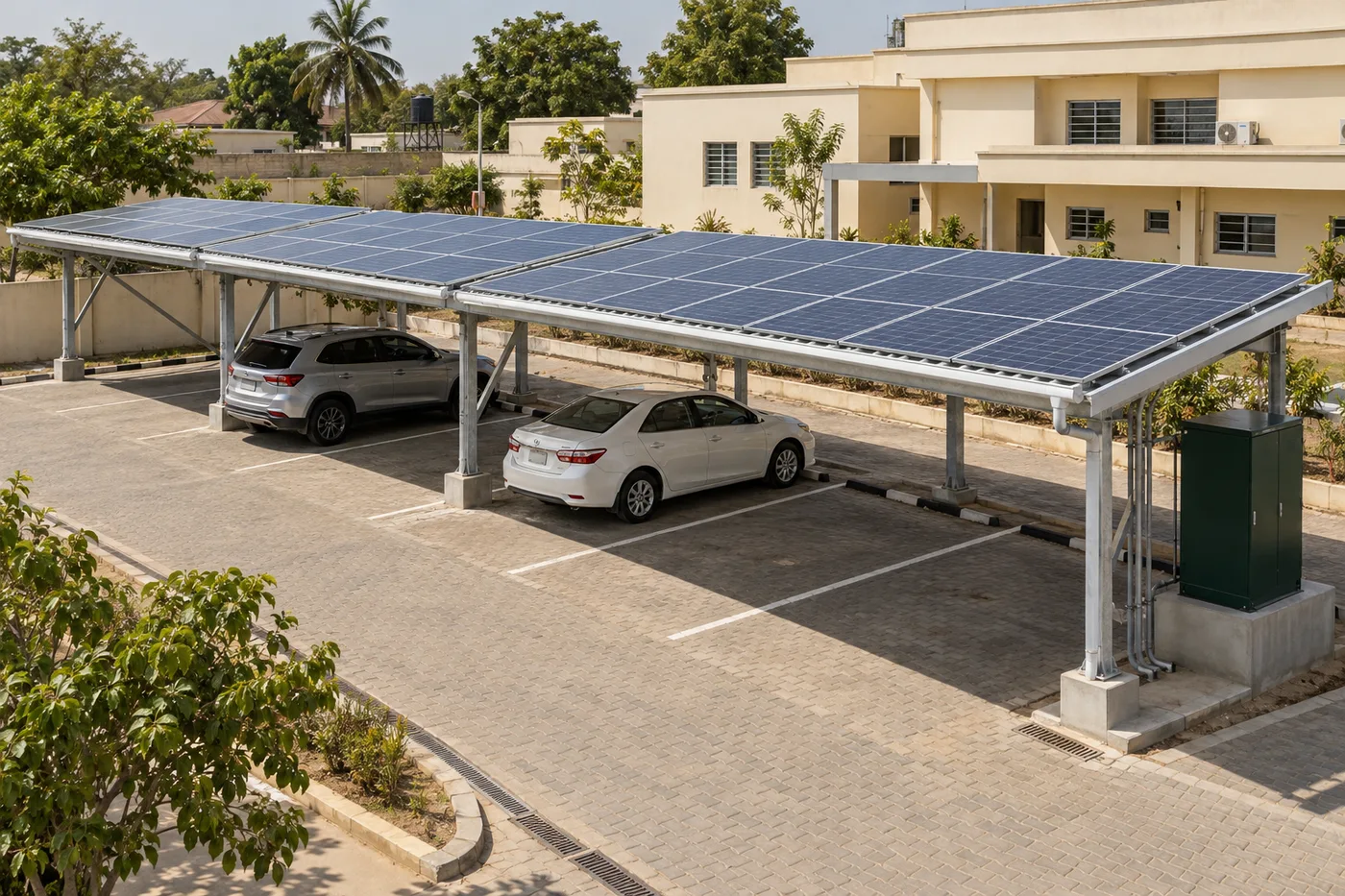
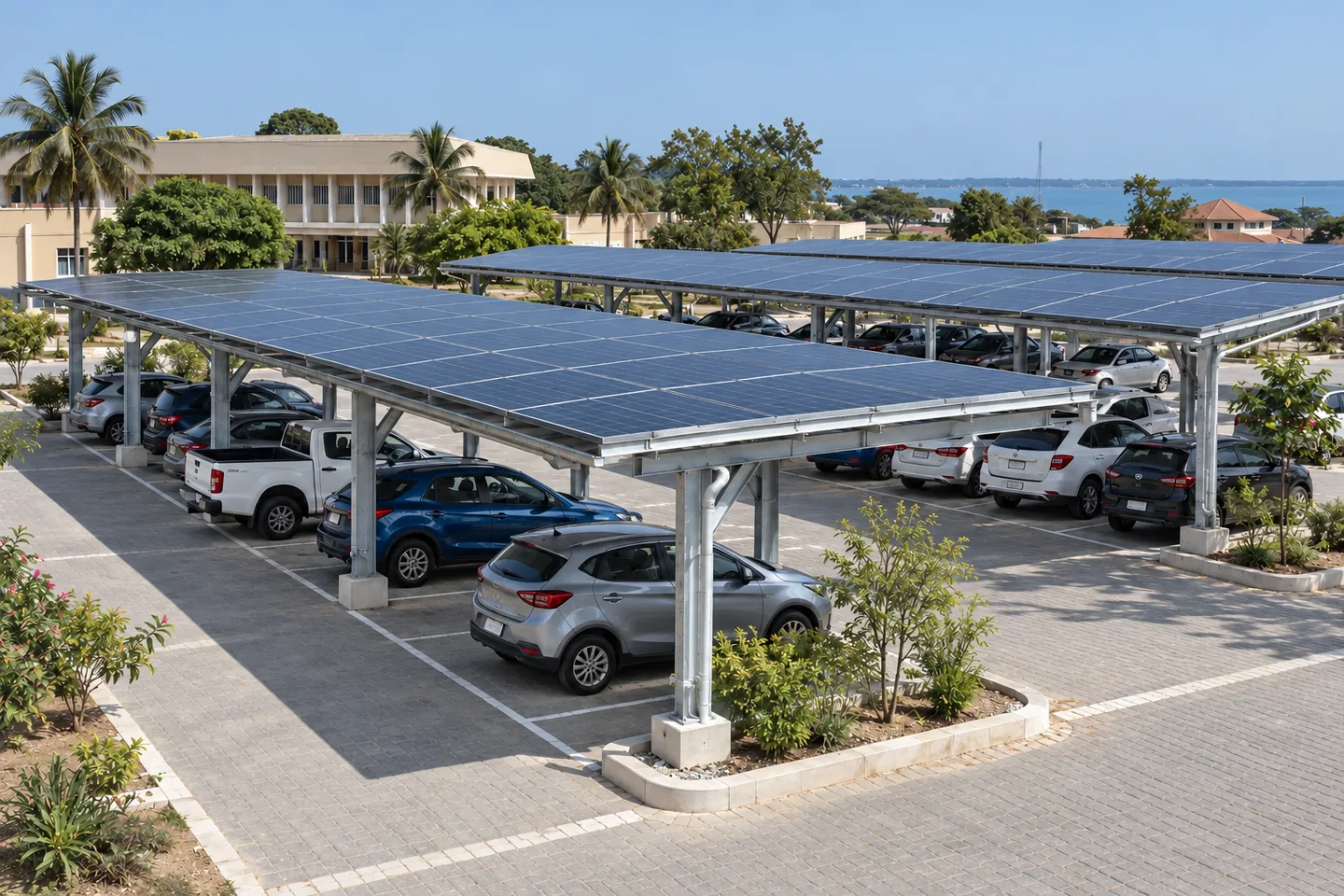
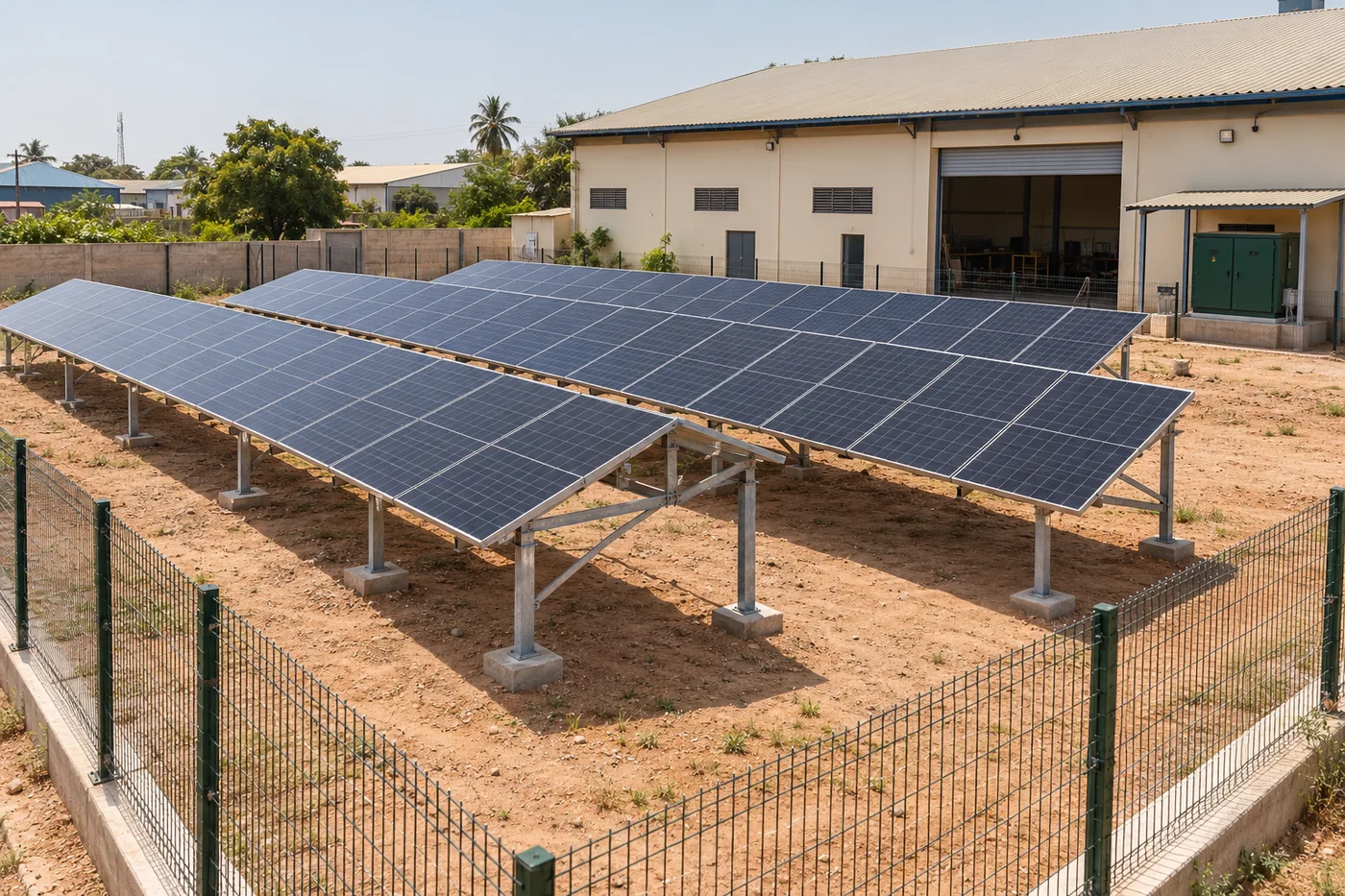
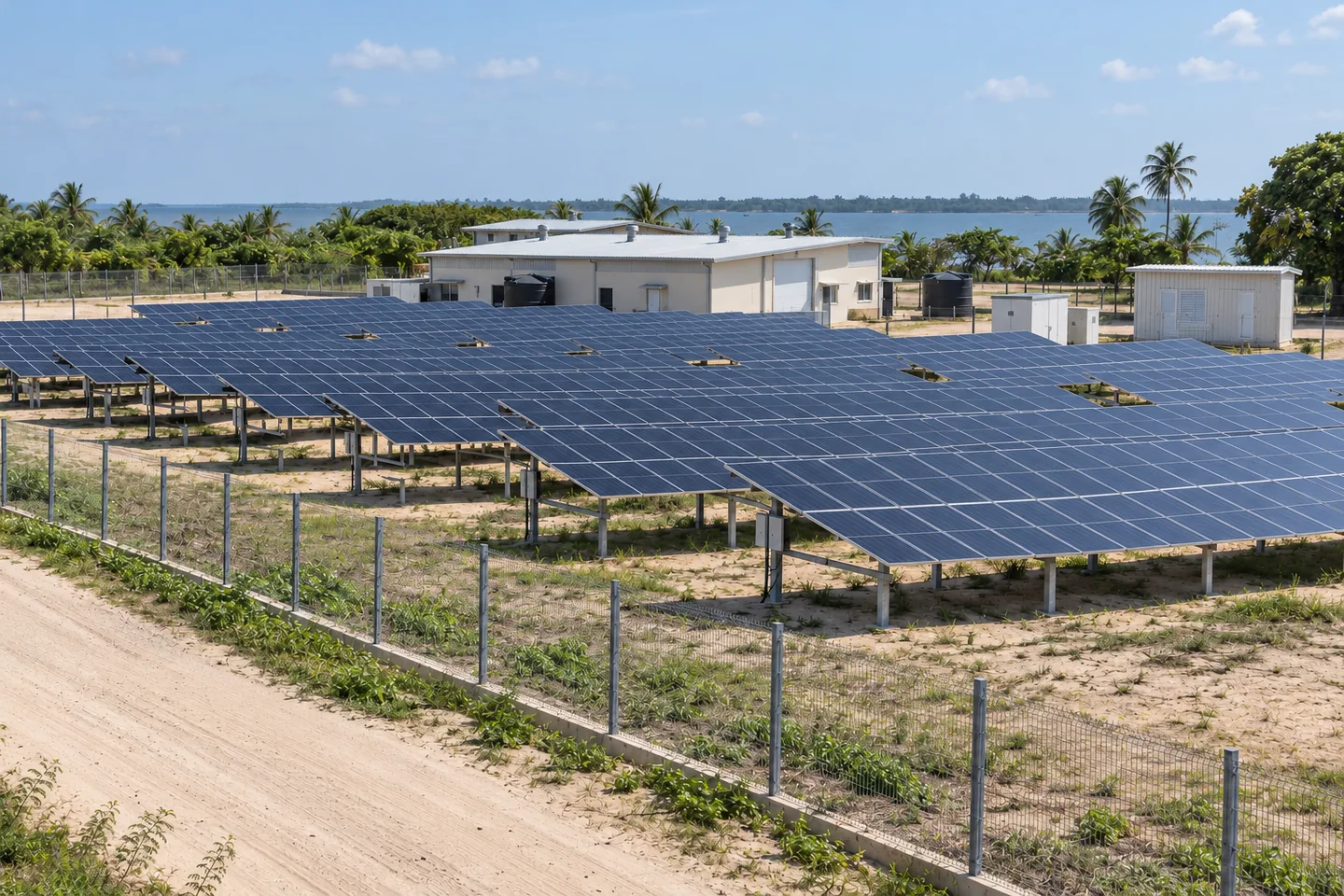
Original concept images. No output, delivered price or installed-project performance is implied by the scale shown.
Joachim leads the qualified technical catalogue. Lamin verifies local buildability, site access and service supply. Dominik owns package costing, funding, customer terms and measured repeat-site economics.
Investment boundary: the $63,000 illustration below is an existing-roof case. New structures, carport/ground foundations, land and larger-scale equipment are not covered by it. Obtain complete variant-specific quotes and recalculate the tariff. No fixed capacity steps, installation time or cost reduction are validated yet.
Inherited sizing hypothesis, not a customer design. Measure demand first. Nominal storage is not usable AC energy or guaranteed backup duration. The 24/7 offer needs a separately qualified and fully priced storage/backup design; the inherited financial model does not validate day-and-night continuity.
Count illustration: 40 × 500 Wp = 20 kWp. No module model or supplier is selected. Confirm shading, usable roof, layout, yield, module certificates, hot-weather output and local warranty support. Actual string design and module count belong in the installer’s quotation. Select a qualified module family that can be reused in the platform; define permitted array/string increments and the inverter/roof limits before expansion.
Roof: check the exact profile, structure, weatherproofing, roof condition and safe access; select a qualified pitched- or flat-roof interface. Canopy: qualify repeatable structural bays with foundations, weatherproof covering, drainage and safe clearance for parking or work. Ground: verify land rights, soil/foundation tests, drainage, security and cable routes before repeating fixed-tilt tables. Reuse approved drawings, fittings and corrosion protection; verify wind and local conditions at every site. Solar modules alone are not assumed watertight. New structures, foundations, ground works and major roof repairs need separate complete quotes; the reference allowance is an existing-roof case.
Illustrative LiFePO4 format: 8 × 5.12 kWh = 40.96 kWh nominal. No battery model or supplier is selected. Include a compatible battery-management system, cabinet/rack, battery disconnects/protection and temperature/environment provisions. Usable AC energy is lower and depends on operating reserve, losses and ageing. Choose capacity from required duty; storage can be reduced if the measured service does not need it. Specify permitted battery increments, compatible inverter/BMS combinations and operating limits; later additions require technical approval.
Select suitable inverter/charger equipment and the solar conversion path: integrated MPPT, separate MPPT chargers or an AC-coupled PV inverter, as designed. Avoid double-counting integrated functions. Phase count, continuous/peak kW or kVA and charge limits follow measured loads and the battery; 20 kWp of panels does not specify inverter output.
Include rated cables/connectors, containment, distribution boards, isolators, fuses/breakers, designed surge protection, earthing/bonding and any required lightning/fire provisions. The designer specifies ratings and quantities from routes, fault conditions, equipment and applicable rules. No generic component basket substitutes for the protection design.
Define the customer delivery boundary and an accepted billing meter, calibration/verification and readings. Measure grid and generator contributions where needed to allocate costs; a controller’s monitoring meter is not automatically a lawful revenue meter. Agree tariff, source-energy/fuel treatment and invoice checks.
A compatible EMS/controller, required communication cables and a site-appropriate internet/data plan. Configure monitoring, local records when offline, alerts, permissions and backups. Start with standard tools and a simple invoice/maintenance ledger; a custom platform is not required for site one. Reuse one qualified control/metering interface and commissioning template across configurations.
Assess the existing connection, protection, metering and transfer/maintenance-bypass arrangement. Obtain the applicable NAWEC/PURA requirements, including anti-islanding and permitted operating mode. Surplus can serve suitable on-site demand or charge storage; when neither is possible, curtail. Export only under an approved technical and commercial arrangement.
Survey the actual generator, controls, service condition, phase/rating and fuel responsibility. Specify compatible transfer/interlocking, input limits, start/stop integration if supported and maintenance bypass with the qualified team. A dual-input inverter is one possible architecture, not a selected model. The reference budget excludes a new generator and its fuel.
Include engineering, installation/lifting, independent checks as needed, commissioning, as-built drawings, test records, operator training, warranties and initial spares. Agree cleaning/inspection, fault response, local technician access and replacement reserve. Acceptance must test actual grid, storage, generator, metering and protection modes. Reuse the reference installation checklist, training package, documentation format and spare-parts list, recording any approved site-specific changes.
Joachim coordinates the technical package with qualified designers. Lamin confirms local delivery and service. Dominik reconciles the quote, contract and cash plan.
PV, conversion, suitable storage, protection, metering and control: named models, compatibility, ratings and complete quantities.
Qualified Roof, Canopy or Ground drawings, load/structure/foundation checks, water management, corrosion protection and installation method.
Approved tests for each operating mode, as-built records, training, local technician coverage, warranty route and priced spares.
Document permitted additions and triggers for redesign. Approve changes to inverter, battery, protection, structure or connection before expanding.
Release condition Signed-off design and interface checks, versioned bill of materials, priced delivery/operation, and documented acceptance. These are required outputs, not completed or certified Tilo Power products.
Theatre, ICU, medical UPS and clinical redundancy need a separate qualified design. Payment disputes must not lead to improvised disconnection of clinical circuits.
GAM-Solar and Shyben are existing enquiry routes for installation and generator expertise, not selected providers. Local legal, electrical, structural, metering and insurance specialists must qualify the final scope.
Fifteen researched prospects from the Gambia work. Begin with Sharab, Africmed and African Princess to compare one defined routine load. Check current assets, contracts, decision authority and payment capacity before proposing a system.
Research leads, not customers, partners or confirmed demand. Prospect evidence retains its 15–16 October observation dates. Africmed services and African Princess room inventory were rechecked 19 October; Sharab’s direct page timed out in that recheck.
Research prospect · no customer interest or energy gap confirmed.
Research prospect · no customer interest or energy gap confirmed.
Research prospect · no customer interest or energy gap confirmed.
Research prospect · no customer interest or energy gap confirmed.
Research prospect · no customer interest or energy gap confirmed.
Research prospect · no customer interest or energy gap confirmed.
Research prospect · no customer interest or energy gap confirmed.
Research prospect · no customer interest or energy gap confirmed.
Research prospect · no customer interest or energy gap confirmed.
Research prospect · no customer interest or energy gap confirmed.
Research prospect · no customer interest or energy gap confirmed.
Research prospect · no customer interest or energy gap confirmed.
Research prospect · no customer interest or energy gap confirmed.
Research prospect · no customer interest or energy gap confirmed.
Research prospect · no customer interest or energy gap confirmed.
Industrial prospects belong to a later dedicated case. Room counts, historical factory capacity and advertised services are not measured electricity loads.
The $63,000 case assumes an existing roof. Canopy and Ground variants need their own complete quotes: structures, foundations, land, cable routes and larger equipment are not covered by that reference. Recompute the tariff for the chosen package. Platform-development costs also need quotes; no standardisation savings are deducted.
Inherited planning model, not quotations or a customer offer. The storage-inclusive case is operating-cash positive, but does not recover its stated ten-year capital target at the assumed $0.28/kWh tariff.
Prove the customer benefit and collected tariff before funding equipment. More battery is not automatically a better business.
After operation + reserve.
Before tax, financing and capital recovery.
After operation + reserve.
Before tax, financing and capital recovery.
After operation + reserve.
Before tax, financing and capital recovery.
Capital-recovery check0 of 3 cases meet the model’s ten-year, 10% capital-recovery target. Rework scope, costs or price before committing.
Illustrative annual-yield equivalent months, not a seasonal cash forecast. USD, before tax, founder pay/travel and debt service. Sold share combines losses, curtailment and demand matching.
Request all three against one measured load, one service boundary and a clearly stated Roof, Canopy or Ground format. No alternative equipment size or price is assumed.
Meet a defined daytime load; price storage only where the measured service requires it.
Check Usable daytime demand, curtailment, grid/generator boundary and what happens outside solar hours.
Add storage for specified loads and an agreed duration.
Check Usable AC energy, peak demand, autonomy, temperature/ageing allowances and a replacement schedule.
Quote day-and-night supply to the agreed loads using solar, suitable storage and compatible backup.
Check Night peaks, poor-sun periods, usable battery energy and ageing, dependable backup/fuel, maintenance cover, acceptance tests, response times, exclusions and remedies. Price all equipment, works and ongoing obligations.
Joachim: common technical specification and approved exceptions. Lamin: local works, logistics, duties and service coverage. Dominik: complete cash costs, customer terms and monthly payment scenarios.
Each quote must separate equipment; mounting/structure/civil works; freight and tax treatment; installation and approvals; operating costs; replacement timing; guarantees and exclusions; currency and validity. Unpriced items remain visible.
Use the shared quotation brief · MDKeep the other reference inputs unchanged. These arithmetic tests do not prove a configuration or a customer-accepted tariff.
No inputs changed.
A sensitivity, not a cheaper supplier quotation.
Only sold share changes from 85%; demand fit is unproven.
At the assumed $0.28/kWh: the reference operation supports about $27,240 of deployment capital under the same 10-year / 10% rule, versus $57,000 assumed. This excludes tax, debt, company development and separate liquidity. Lower storage is worth quoting, not assumed to close the gap.
Capital target formula is unchanged. Cost −20% gives $45,600; higher sold share gives 2,612.5 delivered kWh/month instead of 2,337.5. Replacement reserves are not a substitute for an actual replacement schedule.
| Scope | Range | Selected |
|---|---|---|
| PV, mounting + DC works | $7–11k | $9,000 |
| Battery equipment | $14–22k | $18,000 |
| Conversion, controls + protection | $6–10k | $8,000 |
| Installation + existing generator interface | $5–9k | $6,500 |
| Freight, clearance + provisional taxes | $4–8k | $6,000 |
| Engineering, permits + agreement | $2–4k | $3,000 |
| Deployment contingency | $4–8k | $6,500 |
| Deployment | $42–72k | $57,000 |
| Liquidity | $4–10k | $6,000 |
| Combined funding | $46–82k | $63,000 |
Outside scope: a new roof or canopy (including structure, foundations and weatherproofing), land, major roof repairs, new generator, fuel stock, clinical UPS/redundancy, founder pay/travel and a second site. Provisional clearance/tax allowances need product classification and a broker/accountant. No tax exemption is assumed. Recoverable VAT can still create a cash-timing gap.
20 kWp × 1,650 kWh/kWp/year × 85% sold ÷ 12
= 2,337.5 delivered solar kWh / month
Covers operation + reserve. Does not recover installation.
Adds ten-year recovery of $57,000 at a 10% hurdle. Liquidity separate.
Capital tariff = variable cost + (monthly fixed costs + reserve + capital-recovery charge) ÷ delivered kWh. The annual capital-recovery factor is r ÷ [1 − (1 + r)−n].
Lower the sold share, raise replacement costs and compare smaller storage. Stress a 15% GMD depreciation against USD equipment and delayed customer payment. Indexation is a negotiation and affordability issue, not an assumed right.
Grid purchases and generator fuel are outside this solar-only model. Meter and allocate them separately or add their full costs. No export, subsidy or uncommitted funding receipts are assumed.
The original Gambia detail informed this project room. Data is dated, prospects are uncontacted and allowances need quotes. No contract, licence, partner capacity or saving is represented as secured.
Advertises 141 rooms/suites with air conditioning and mini-fridges. This is not measured occupancy, electricity demand or willingness to buy.
Figure 2.7 places The Gambia among countries with high reported outage incidence. The figure uses 2023/24 Enterprise Survey estimates; it is not a current outage forecast or a survey of our prospects. No exact chart-derived percentage is promoted in the short reading layer.
PURA still displays 2023 determined rates: commercial 14.90, hotels/industry 15.90 and central government/area councils 16.20 GMD/kWh. Confirm the actual bill, customer class and any later decision before pricing. None is a Tilo Power tariff.
Obtain the applicable site-specific generation, supply and grid-connection requirements. Calling electricity a service does not itself remove licensing obligations.
Publishes Gambian commercial projects, including lease references. Existing assets, dates and contract status must be checked; financing alone is not an unoccupied market.
Describes dependable, affordable energy as a foundation for productive activity, employment, business development and economic growth. Supports the economic rationale, not a claim that electricity alone guarantees success or that Tilo Power already delivers lower costs.
Explains how high electricity costs and unreliable supply can constrain firms, productive technology and employment. Regional context, not measured evidence of Tilo Power customer demand, savings or operating performance.
Appendix p.11 reports a weighted outage estimate of 86.9%, rounded to 87% on the main page. Interviews: 162 firms, May–September 2023. Scope: covered non-agricultural formal private firms with 5+ workers; healthcare, informal microbusinesses and several other sectors are excluded. Retrospective survey context, not a 2026 outage rate or Tilo Power results.
The World Bank reports approved financing of $160 million for Togo and The Gambia together, including distribution-network expansion and access improvements. This is programme context, not Tilo Power funding, demand or completed results. Compare site economics under better grid availability as well as current supply.
Illustrates inverter/charger, batteries, controller, meters and alternative AC/DC solar coupling. A manufacturer architecture example, not our selected hardware or Gambian approval.
Relates storage and inverter sizing to system duty and expected loads; addresses anti-islanding. Does not size our site or establish local grid-code acceptance.
Includes a 51.2 V / 100 Ah, 5.12 kWh LiFePO4 format and BMS requirements. Eight such nominal units illustrate 40.96 kWh, not usable AC energy, a selected battery bank or a complete offer.
Example of local/remote system monitoring, compatible device integration and offline data storage. Our connectivity, alert escalation, permissions and billing integration still need configuration.
Shows one architecture accepting two AC sources and multi-phase arrangements. Not a selected unit, generator rating, wiring design or clinical continuity guarantee.
Supports rated wiring, fusing and electrical-safety scoping. The site designer must specify actual protection, earthing, cable routes and ratings; no installation instructions are provided here.
Supports structural/electrical assessment, roof condition and safe installation planning. This is a technical checklist reference, not Gambian building/electrical law.
Describes checking supply, storage, metering and generator operation. A qualified team must define and witness site-specific acceptance tests.
Historical technical reference for documentation, maintenance and service scope, not a current Gambian service price or local regulatory approval.
Identifies the electricity regulatory framework and NAWEC’s role. Local counsel, PURA and NAWEC must establish the applicable generation/supply, metering, grid and export route for the proposed site; no threshold or exemption inferred.
Illustrates families of mounting solutions for different roof types. This supports the platform concept, not a selected supplier, a local approval or a new-roof structural design.
Site-specific generation, supply, metering and export requirements must be confirmed. Calling electricity a service does not remove licensing requirements.
£19/day, 14 days £266 ex VAT, approximately $352 at the dated cross-rate. No Gambia delivery, overseas-hire permission or local availability is established.
Replace indicative historical cross-rates with the actual dealing rate when comparing current quotations.
Preserved independently. Legacy fixed-monthly plans, licensing workarounds, assumed savings and unrelated ventures are not adopted by Tilo Power.
Primary references reviewed 19 October 2026. They inform the product approach; no supplier, partnership, local certification or Tilo Power performance is established.
Manufacturer catalogue. Short-rail families and defined roof/material constraints support a repeatable pitched-roof interface; they do not validate a local Tilo Power installation.
Manufacturer reference for profile-specific metal-roof attachment. Clamp and bracket selection must match the actual roof and tested load path.
Manufacturer reference for low-profile flat-roof arrays. Ballast and fixed attachment depend on roof properties and the qualified project design.
Manufacturer product announcement, 7 March 2024. Shows repeatable structural bays and optional roof covering/drainage. Site structural calculations remain necessary.
Manufacturer brochure, 2024, printed pp. 22–27. Repeated fixed tables and foundation alternatives informed the ground concept. Soil investigation remains a prerequisite.
Manufacturer design guidance. Storage and inverter sizing depend on loads and operating mode; export control and anti-islanding require compatible equipment and applicable approval.
African commercial-energy service reference for an operated, financed electricity offer and phased rollout. Its prices, savings, funding and project achievements are not Tilo Power claims.
Gambian regulator. Obtain the applicable supply/generation and connection authorisations for each service scope; a catalogue package does not remove these requirements.
Primary manufacturer reference rechecked 19 October 2026: remote monitoring, alarm reporting and logged energy data need compatible hardware and a data connection. This informs the proposed Tilo Power monitoring layer; no completed Tilo Power software or supplier partnership is established.
Primary manufacturer reference rechecked 19 October 2026: generator control can use configured battery-state and load conditions. Generator interface, transfer/protection, fuel, maintenance and approvals must be qualified per site. No instant or universal changeover is claimed.
Architectural concept images include AI-generated illustrations; diagrams and the modular product film are original explanatory work. They do not depict installed Tilo Power projects. Team photographs are supplied real images. Fonts: Inter and DM Mono; licences included locally.
Before ordering equipment
Approved design. Agreed customer. Complete funding.
Then install, commission and prove the service.